Appearance
FAC-MAR-02 · High-alert and controlled drugs: witness, register, and pharmacist verification
Insulin, anticoagulants, opioids and the like are where a single slip does the most harm. Verabase adds three checks. A second person signs with their own password. The actual dose is recorded when the prescription is a plan, such as a sliding scale. And every controlled-drug ampoule is counted out of its cupboard in a register that can't go below zero. Pharmacist verification sits in front of all of it: whether an order must be checked by a pharmacist before its first dose is the hospital's choice.
Why this matters
Controlled-drug registers are a legal record, and a count that doesn't balance is an incident. A witness who only types a name hasn't witnessed anything. A sliding-scale insulin charted as "6 IU as prescribed", when the nurse actually gave 4, is a wrong record.
Before you start
- Nurse:
nurse.eze@demo-clinic.test. Witness:nurse.bello@demo-clinic.test. Pharmacist:pharmacist@demo-clinic.test. Facility Admin (for the setting):admin@demo-clinic.test. All passwordsVerabase-2026, except the admin's (DemoAdmin-2026). - The demo HDU has sliding-scale insulin (high alert) and PRN morphine (controlled) with 20 ampoules received into the HDU cupboard.
Steps
1. Sliding-scale insulin — as Nurse
Record the insulin dose, choose Given, and work through the form. For a variable plan it shows the prescriber's plan (Sliding scale plan: capillary glucose before each dose…) and asks for the Actual dose given. It also asks for the injection site, so the next nurse can rotate. Before you can confirm lists everything still missing:
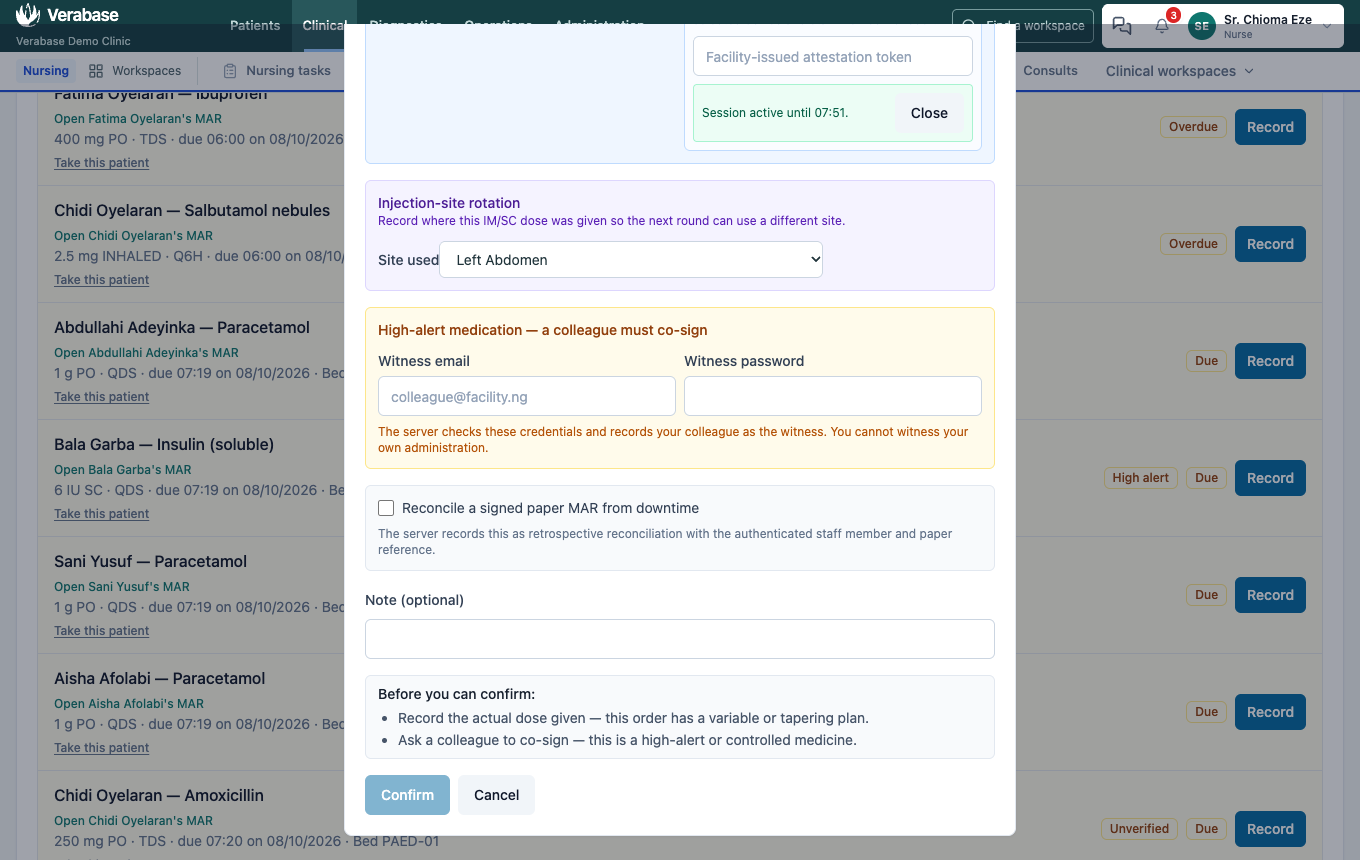
Enter the actual dose (e.g. 6 IU (capillary glucose 12.4 mmol/L)). Then your colleague types their own email and password under High-alert medication — a colleague must co-sign. The server checks the credentials and records the colleague's name, not what was typed.
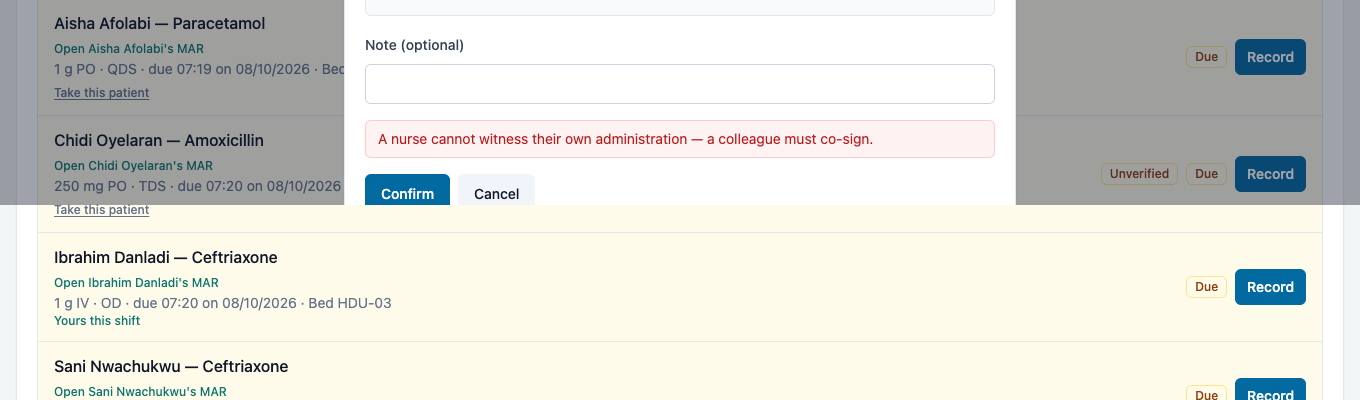
You can't witness your own dose:
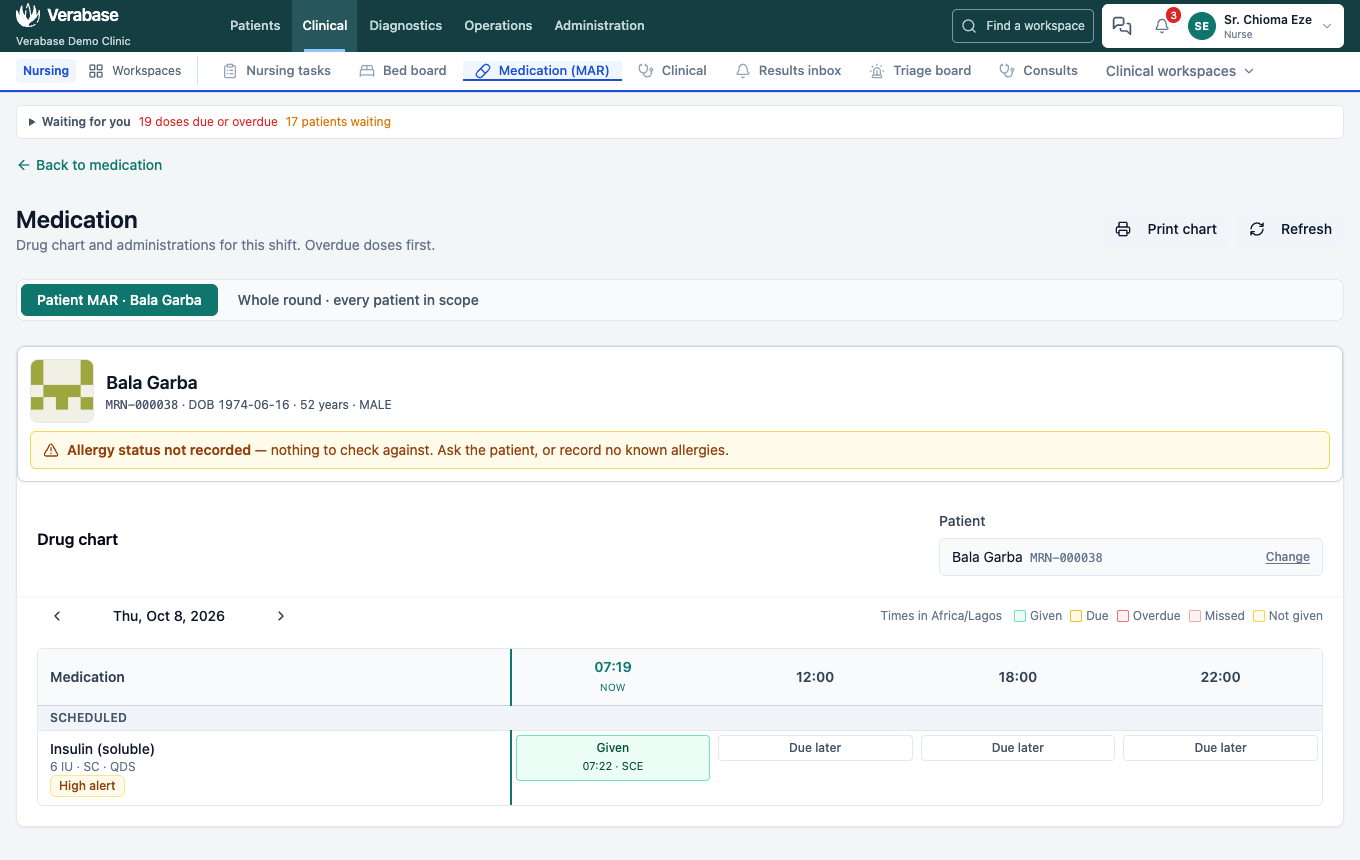
With a colleague's signature it's recorded, and the drug chart shows the dose as scanned and given:
2. Verify the morphine order — as Pharmacist
Medication (MAR) → Current orders shows each order's verification: Awaiting pharmacist verification or Verified by …. Choose Verify (or Reject… with a note the prescriber will read).
3. Give the morphine — as Nurse
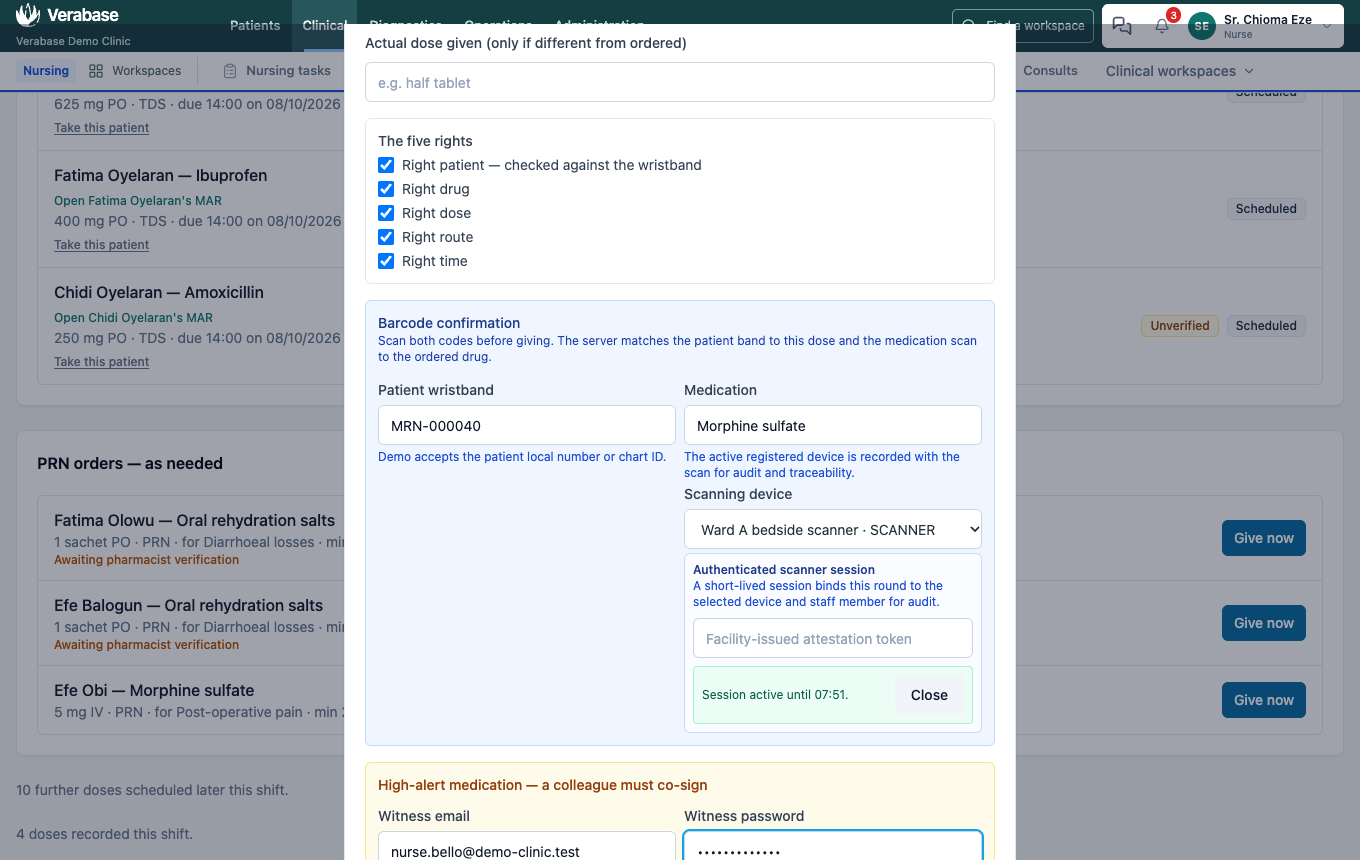
Give now on the PRN morphine. A controlled drug needs everything a high-alert drug needs, including the witness:
4. The controlled-drug register — as Pharmacist
Pharmacy → Controlled-drug register lists every movement:
- Received, Issued, Given on the MAR, Wasted or Count adjustment
- the drug and its cupboard (the pharmacy store or a ward)
- who witnessed it
- the running balance, counted in the register's own unit (ampoules here)
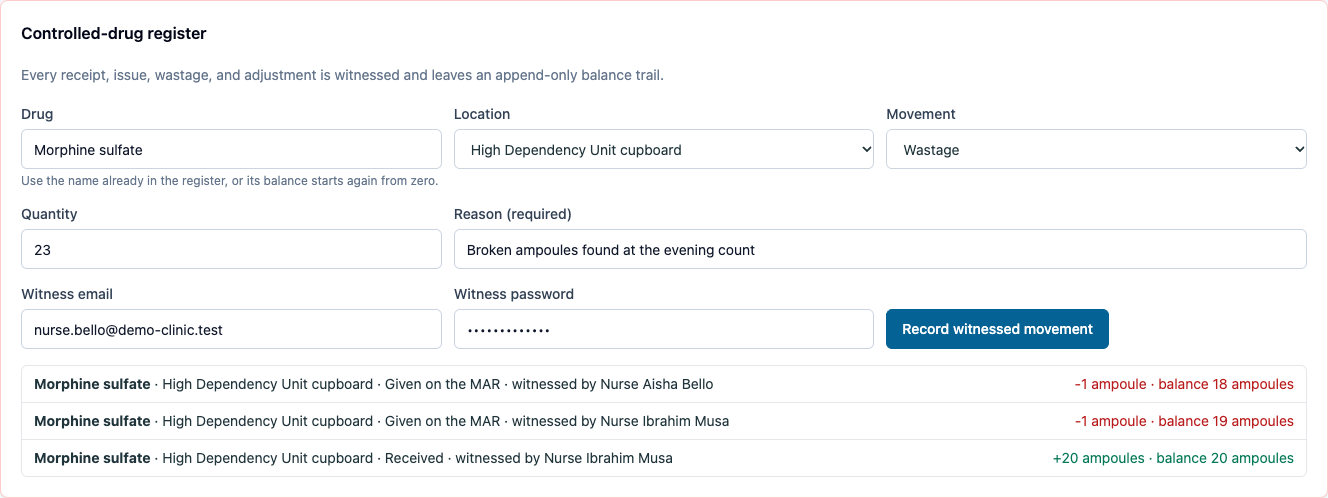
The dose given on the MAR has already been counted out: −1 ampoule · balance 18.
To record a receipt, wastage or count correction: choose the Drug (use the name already in the register, or its balance starts again from zero), the Location cupboard, the Movement, the Quantity and a Reason, then have a colleague sign as Witness. A movement that would take the cupboard below zero is refused:
5. Warn or Block — as Facility Admin
Pharmacy → Prescribing integration → Pharmacist verification before a dose is given:
- Warn (the default): an unverified order can be given. The round and the dose form both say Not yet verified by a pharmacist.
- Block: no dose of an unverified order can be given. Turn this on once the pharmacy verifies orders around the clock.

With Block on, the nurse's Confirm on an unverified order is refused:

What Verabase will refuse and why
| You try to… | Verabase says | Why |
|---|---|---|
| Give a high-alert or controlled drug without a witness | Ask a colleague to co-sign — this is a high-alert or controlled medicine. | Two people check the drug, the dose and the patient |
| Sign as your own witness | A nurse cannot witness their own administration — a colleague must co-sign. | A witness is a second person |
| Give a variable-plan dose without the actual dose | Record the actual dose given — this order has a variable or tapering plan. | The chart must show what was given, not what was planned |
| Record a movement that takes a cupboard below zero | This movement would make the controlled-drug register balance negative. | Controlled-drug counts must balance |
| Give an unverified order when the hospital blocks it | A pharmacist has not verified this order yet, so this dose cannot be given. | Set in step 5 |
You're done when…
- [ ] High-alert doses you gave carry a colleague's witness signature.
- [ ] Variable-plan doses show the actual dose given.
- [ ] Every controlled-drug dose appears in the register, and the cupboard balance matches the physical count.
Practice task
Give the HDU insulin with a witness and the actual dose. As the pharmacist, verify the morphine; as the nurse, give it with a witness. Open the register and find your dose. Check: the trainer sees your dose counted out with the witness's name and the balance one lower.
Related journeys
FAC-MAR-01 The drug round in depth · IMP-08 Pharmacy routing, barcode policy, scanners · FAC-MAR-03 Downtime